The “problem of evil,” even if imprecisely named, remains the most powerful intellectual impediment to belief in God. The world contains extraordinary beauty, joy, and order—and yet also deep suffering. How can these coexist if there is an all-good, all-powerful, all-knowing God? This question is not a modern discovery. It already stands at the centre of one of the most enigmatic and ancient texts of the Hebrew Scriptures: the Book of Job.
In Job, the protagonist is not a sinner reaping moral consequences but a righteous man subjected to catastrophic loss. His children die, his wealth collapses, his body is tormented. The cause, however, is not human wrongdoing: Satan seeks to test whether Job loves God for God’s sake. God permits the affliction and does not intervene. Importantly, Job knows none of this. From his vantage point, his suffering has no discernible moral cause. It looks like mere misfortune—what we would call tragedy. Job therefore grapples not primarily with human evil, but with the far more bewildering experience of a world that appears arbitrarily broken.
It is here that Job speaks to a contemporary shift. Increasingly, objections to God appeal not to human evil—genocide, cruelty, injustice—but to tragedy: animal predation, natural disasters, genetic defects, cosmic indifference. These are not instances of malice; they are instances of suffering apparently without an agentic source. For many skeptics, this “tragic” register is the most decisive reason to reject theism. God, they argue, could perhaps be defended against moral evil, since human freedom provides some explanation. But tragic suffering seems utterly gratuitous.
The distinction between tragedy and evil is therefore crucial. By “tragedy,” we typically mean suffering without clear human agency: the earthquake, the hurricane, the child’s congenital illness, the deer breaking its leg in the forest. The Greeks saw tragedy also in ignorance and circumstance—Oedipus is ruined not because he chooses evil but because he is caught in forces beyond his knowledge. In these cases, no intentional agent can be blamed. “Evil,” by contrast, names willful destruction: murder, war, cruelty. The Christian tradition has long located this in the rupture caused by human disobedience in Eden. Turning from the source of life, God Himself, humans introduce corruption into their own condition and into the human world. In the Augustinian view, this primal act explains the moral and physical disorder that afflicts humanity.
Yet neither a purely human nor a purely tragic account seems adequate. If all tragedy is the consequence of human evil, how do we explain the immense domain of suffering untouched by human agency—animal suffering, geological violence, the vast pre-human history of death? Conversely, if tragedy is simply “built into” the universe, we seem forced toward a picture of God who intentionally creates pointless suffering. This makes God appear arbitrary at best and cruel at worst. Both options are unsatisfactory.
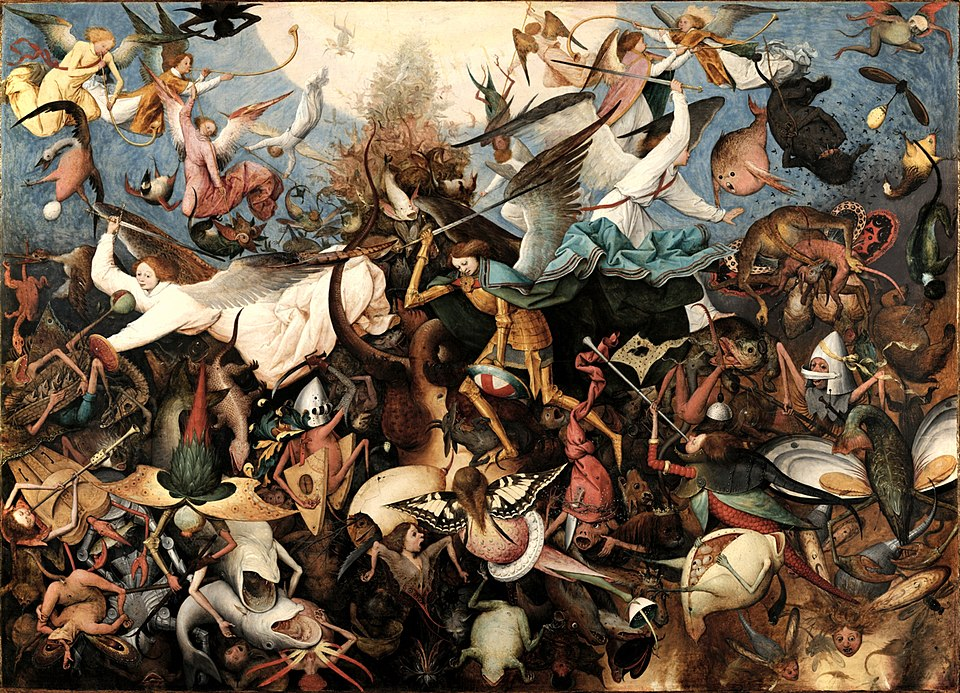
Here the Book of Job offers a third path. Scripture does not portray humans as the only moral agents in creation. Alongside human freedom stands angelic freedom. The fall of Satan and his angels—logically and temporally prior to human rebellion—introduces another source of moral distortion in the cosmos. Job’s story is exemplary precisely because his suffering, though perceived as tragic, is in fact the result of angelic malice. What looks like blind misfortune is, at a deeper register, the consequence of a moral agent.
This does not collapse all tragedy into demonology, nor does it eliminate the human responsibility emphasized in the Augustinian tradition. Instead, it widens the frame. The world is morally complex because the world contains multiple orders of rational creatures capable of turning from God. What we name “tragedy” is often the human experience of cosmic evil whose agency is ordinarily invisible to us. Job’s ignorance of Satan’s role is not an anomaly but a paradigm.
If this picture is true, then theodicy remains what it has always been: an inquiry into how divine goodness coexists not with suffering in the abstract, but with evil—with the misuse of created freedom by both humans and angels. This does not solve every problem, nor will it persuade a materialist who rejects such cosmology altogether. But it clarifies what Christians actually believe and why tragedy, within that framework, is not a challenge separate from evil but a dimension of it.
It also casts Christ’s work in a more expansive light. The Incarnation is not merely God’s response to human sin; it is God’s act of repairing and reclaiming a cosmos wounded by multiple rebellions. The scope is larger, stranger, and more awe-inspiring than a merely anthropocentric narrative allows. If nothing else, this reading of Job reminds us that the world’s tragic appearance need not be the whole story. The moral structure of the cosmos may be deeper than our perception of it—and its restoration more comprehensive than we yet understand.
 Hoping for Clarity
An insightful foray into an ancient debate. Had not realized the shared trend in contemporary atheism. Danke!
LikeLike