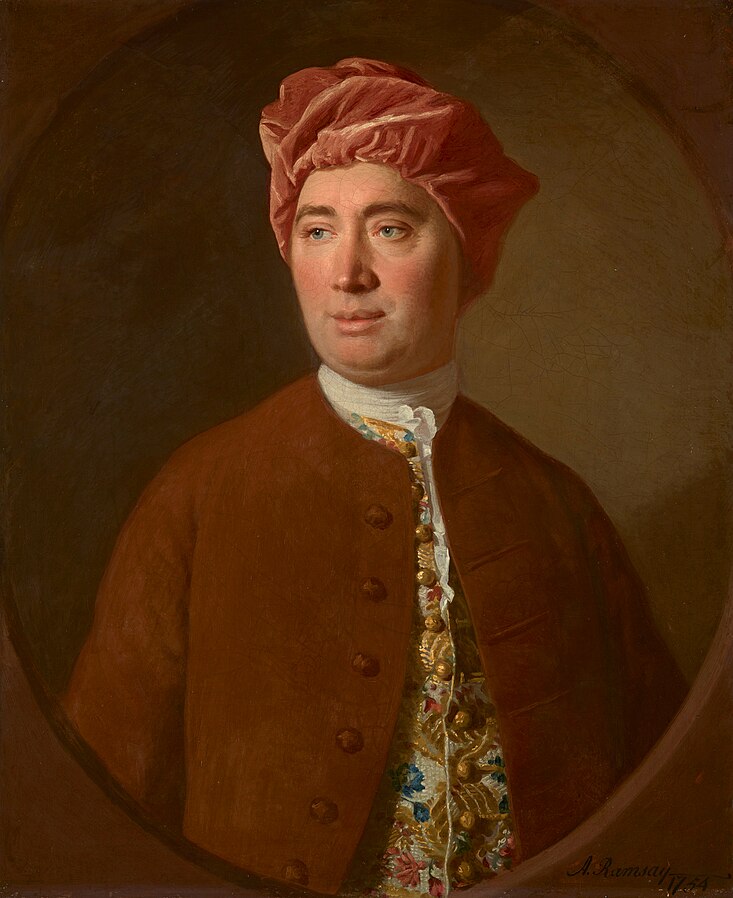
Fresh ink need not always be spilled upon fresh ideas, and I am of the persuasion that revivified thinking may spring from echoes of old debates. For today, I take my task as such a reinvigoration of our thoughts: I want to discuss David Hume’s rejection of miracles – a subject that has perhaps had everything said for and against it, though it can still be used as an example to highlight other tangential considerations. From the outset, it is important for me to say that I am not persuaded by Hume’s argument, and someone who takes himself for my critic might accuse me of being just a foolish religious adherent trying to protect my undue assumptions and superstitions. Against such a claim, all I can ask is that my argument be read earnestly so as to ensure that I am not merely indulging in my prejudices. Herein, I argue that epistemology – the nature of thought – is critical for understanding the validity of any given claim; Hume’s rejection of miracles, therefore, stands in for a negative example of how specific claims may fail due to their neglect of epistemic principles (in this case, Hume’s own).
Hume is, perhaps, the most forceful expositor of an empiricist philosophy, which we could otherwise state as being an empiricist ‘epistemology’ or ‘logic of knowledge.’ In his case, this view should not be understood as synonymous with modern ‘science.’ When we call Hume an ’empiricist,’ then, we do not mean to say that Hume was some kind of luminary of the experimental method (though he certainly appreciated the emerging sciences of his day); rather, Hume is an ’empiricist’ in the most literal sense, as someone who tries. For example, we know about gravity through perpetually lifting things and having them fall back to the ground; we know about the coming sunrise due to it occurring each day; we know the meaning of words due to other people seemingly understanding what we are indicating through our verbal constructions. In this sense, Hume’s understanding of knowledge is best understood as a kind of habit. Knowledge is a recognition of that which emerges repeatedly and consistently, and such claims being synthesized is how we construct our understandings of the world. Along with this view comes a rejection of metaphysical principles: Hume believes that we are, in some sense, confined to the phenomenal and only know about it through repetition; from such a standpoint we cannot claim to know that which is beyond the phenomenal world (as a brief aside, this claim from Hume inspired a great deal of Kant’s philosophy – a rather fascinating example of Scottish influence in Germany). What Hume therefore thinks of as a ‘natural law’ is that which is consistent with repeated experiences; the claim that all human beings die is one such observation, and there is no a priori or ‘metaphysical’ manner in which this claim can be known – it is ’empirically’ derived.
This final point about natural law is crucial, as Hume argues that a ‘miracle’ is that which violates a natural law. Continuing the claim about the natural law of all human beings dying and decaying, Hume believes that an account of something like a resurrection should not be believed because it defies our understanding of nature. He suggests that a promulgator recounting such an instance is more likely mistaken about the occasion or lying about the facts for some other reason. Perhaps the person who is thought to have been resurrected was never actually dead in the first place and simply woke up, or the teller of the tale has something to gain (like fame or money) in perpetuating the supposedly miraculous event. Though there is something to be said for thinking skeptically about hearing such miracle accounts from others, I do not wish so much to weigh in on the testimonial aspect of Hume’s argument here but instead upon the substance of a given claim. Hume’s argument logically extends to that of one’s own experience: if I believe that I just saw a dead man rise, I should reflect on the more likely possibility that I am mistaken so as to cohere with the natural laws that I have learned from my experience broadly.

Despite that this may seem a niche topic, this view is one that I hear repeated in many philosophical and theological debates today. Most commonly, this comes up in conversation about the resurrection of Jesus Christ – the pivotal claim that animates Christian believers. Many non-believers and critics of Christianity reject the claim about Jesus rising from the dead by reference to the ‘natural,’ one may say ’empirical,’ observation that everyone dies and stays dead – thankfully, people are not frequently known to be banging from within their coffins. Importantly, the Resurrectional claim’s historical element is frequently neglected; instead, a ‘natural law’ has been constructed by abstracting from the experiences of one’s own life and is taken to preclude even the possibility that such occurrences could happen. I will grant that Hume is slightly more careful than most others in that he does not quite absolutize his view. Instead, he makes a probabilistic claim that such a violation of a natural law – which are aggregated claims formed from our experiences – is so unlikely as to be simply rejected; it is more likely that we are mistaken than that the generalized natural laws we have come to know about reality were violated.
This view, however, relies on a number of peculiar ambiguities. One critical issue is the relationship between the specific ‘instances’ of our lives and the generalized views about life they help to form. What is unclear about Hume’s view (echoed by some today, even if unknowingly) is how these specific instances inform our generalized notions, and how we use the general notions to think through our specific experiences; in this case of miracles, Hume is using a constructed natural law about all men dying to say that no one rises from the dead. The obvious problem with this is that the aggregated view, the ‘natural law,’ is predicated upon many (though, of course, not all – as that is impossible to collect) specific instances being synthesized into a singular, abstracted claim. Hume then uses this ‘law’ to suggest that it can refute certain empirical inputs (meaning new ‘instances’) that seemingly violate the law. But why should this additional instance not be factored into the original, aggregated natural law? There appears to be a somewhat arbitrary line drawn around what is considered legitimate to include in the natural law as he understands it himself.
This is problematic for Hume (and his followers) because it confuses the very nature of an empirical philosophy. Imagine a man observing what seemed to be a genuine resurrection right before his eyes: should he reject this experience because it seemingly violates what was known through his prior experiences and abstract claims derived from it? Even if only modestly, this suggestion seems to undermine the empirical commitment. Hume’s argument relies on rejecting the possibility of accepting new observations due to one’s commitment to an abstract rule derived from prior observances – in this case, a natural law about death being universally final and resurrection therefore being impossible. In my view, this move seemingly raises an abstract derivation from experience over the actuality of what we may observe. Hume, therefore, should only be able to say that a miracle is incredibly unlikely – not that we should reject any possibility of one occurring or always assume we are mistaken if we seemingly observe one. Moreover, this is also precisely what is claimed for the miraculous: that it is a profoundly uncommon experience, hence its impact and noteworthiness.
Now, perhaps you are dismissive of the possibility of miracles as is Hume, which is fair enough. My purpose in looking at Hume’s position is not so much to make you believe that miracles are possible but to demonstrate how the claims we make are always interlocked with an understanding of our thinking that undergirds our claims (a reality that is always, at least, implicit). In Hume’s case, empiricism is shown to have various nebulous details that come to a head by looking at a specific argument he makes; his rejection of miracles seemingly confuses (or even undermines) his commitment to empirical observation because his dismissal of the miraculous requires a prioritization of an abstract rule derived from a series of other observed instances. How many instances are sufficient for the generalized ‘natural law’ claim to hold? How can one say that a novel experience, even one that seemingly contradicts others we have had, is impossible if we only ever have new experiences to inform our thoughts? Hume is seemingly reduced to making ‘common sense,’ probabilistic arguments – but these offer no clarity about the nature of our thinking and what is possible to understand, which seriously weakens the force of his claim about miracles being impossible. Thus, either Hume’s empirical philosophy needs revision or his particular claim about miracles must be changed – neither of which is self-evidently the correct choice. We would need to think through both possibilities.
This, in my view, is the importance of philosophy, especially insofar as philosophy focuses upon epistemology. I tend to believe that philosophy is thinking about thinking, understanding how we understand , etc. This is a worthwhile exercise as specific claims or conclusions require that we understand the nature of the thought that determined them. If we are truly mere contingent creatures confined to the phenomenal world, there should be no way for us to make any absolute claims about experience; this is a necessary conclusion given such a philosophy, and therefore someone holding to that philosophy should be questioned if they derive any absolute conclusions about experience. Despite this, I would also acknowledge that philosophy so understood does not offer a total vision; specific claims frequently need to be addressed on other grounds, and a given philosophy can be open to a wide variety of contrary views within itself without contradiction. If Hume’s argument is confined to the probabilistic, perhaps we can acknowledge that he has made a good point – but there is not, as far as I can tell, anything about empiricism that precludes the possibility of miracles.
I do believe that Hume is incorrect about miracles, even on Hume’s own philosophy, though I also do not believe that empiricism is a sufficient basis to understand thinking. I think Hume’s theory is weakened by not providing any clear theory of mind, which comes out particularly in the ways that Hume’s philosophy does not seem to have a strong explanation for the nature of historical thinking or a clear definition of how facts are derived in the many ways that we do so. A more rigorous understanding of thinking and what it depends upon is in order, though we will need to hold our judgement on whether or not a superior epistemology is a friend or foe to claims about miracles.
 Hoping for Clarity