When I was atheistic in my self-consciously held beliefs, I was dismissive of the Bible in many ways. As is the case for many non-Christian critics of Christians, I would accuse believers of never reading their Bibles; if they had read their Bibles, I would then trot out the usual panoply of complaints about the Scriptures’ contents. Slavery is, perhaps, the go-to example for many, but another that I tended invoke was the story of the Binding of Isaac from Genesis 22:19. Who could believe in a god that nearly abetted a human sacrifice? Probably the same one who would sacrifice his son on a cross to allegedly save humanity! The hermeneutic used to make this claim, however, is rather superficial: a god tells a man to kill his son, and that is bad. There are a great many obvious answers to this reading of the story: what do you mean by ‘bad’? What is meant by god, and are you really in a position to question him? Can that story be taken as simplistically as it is being recounted here?
This last rejoinder is the question that most intrigues me, and it brings us back to that unnecessarily intimidating word: hermeneutics. If we desire simplicity, we might just call this ‘interpretation,’ but I think these words – for my present purposes, especially – are virtually interchangeable. To investigate one’s own hermeneutic, he must ask certain questions of how he is reading a given text: What assumptions or expectations am I bringing to the text in order read it and understand it? What sorts of questions informed the writing of a given text, and have I discovered these questions adequately to then comprehend how they were answered? I am quite persuaded by R. G. Collingwood that any given argument or investigation can only be followed by determining the questions that put the inquiry in motion in the first place; as responsible readers of any text, I believe we must first seek the questions that motivated the telling, writing, and codification of the Bible which will then allow us to understand the answers provided.
In my view, this will help uncover a fundamental confusion about the Bible and those who believe it. When the Bible is taken as the book from which Christians supposedly derive their worldviews and moral opinions, this often leads people to assume that it is akin to some kind of manual for living a moral life. Just follow step one, then two, then three, and a dandy fellow you’ll be! This, however, I take to be an evident error, and one which is liberally committed. The Bible is not merely a set of answers to questions such as: What things should I not commit? What are the actions that make me a good person? No, the Bible is asking a much more profound and reaching question: What does it mean for me, a human being, to live in accordance with the will that moves existence itself? We will note that this query has some fairly loaded aspects that themselves must be considered in the process of answering the question, but this should not suggest to us that we must halt the investigation.
To express this insufficiently, the anthropology initially expressed in Genesis (prior to the Binding of Isaac) speaks of the Fall of Humanity despite God’s good intent and design in human beings. More specifically, human beings (typified by Adam and Eve) attempt to obtain the knowledge of good and evil while turning away from God; their attention falls from the Supreme Source of all Being to seeking the fullness of life in something merely bodily, something in the world: a fruit, an item to be consumed. Another way we might understand this is that human beings inverted the proper perception of their place within existence by pursuing a specific good within the world as opposed to properly recognizing that they ought to order themselves within the world relative to its coherent totality – but this is a task only feasible through Divine guidance because man is in the world and therefore can never fathom the Whole of Being. In my understanding, this is the core of sin as articulated Biblically: seeking salvation (in its root, meaning the pursuit of health, or what we might consider as ‘life’) in that which is merely a part of the world as opposed to in accordance with the Will that orders the world as such.
The Bible, then, is a recounting of the ways in which God has attempted to reform human beings to His Will in order to reform them from the degradation that resulted due to their varied attempts to seek salvation in that which is merely of the world. This provides the backdrop of human suffering at a macro-level that becomes relevant in specific instances for each human life; the human predicament is a universal appearing everywhere as a particular. This means that the manner in which sin, this turning from God, occurs is incarnated in specific ways throughout time and space. There can, however, be more specific forms that nonetheless have a wide relevance through a certain sort of archetypal generalizability. In my view, the Binding of Isaac is such a story, but it cannot be taken in abstraction from the life of Abraham as such; moreover, we must then look at ourselves in order to consider the ways in which Abraham’s wrestling with God is akin to the struggles of our own hearts today and every day.
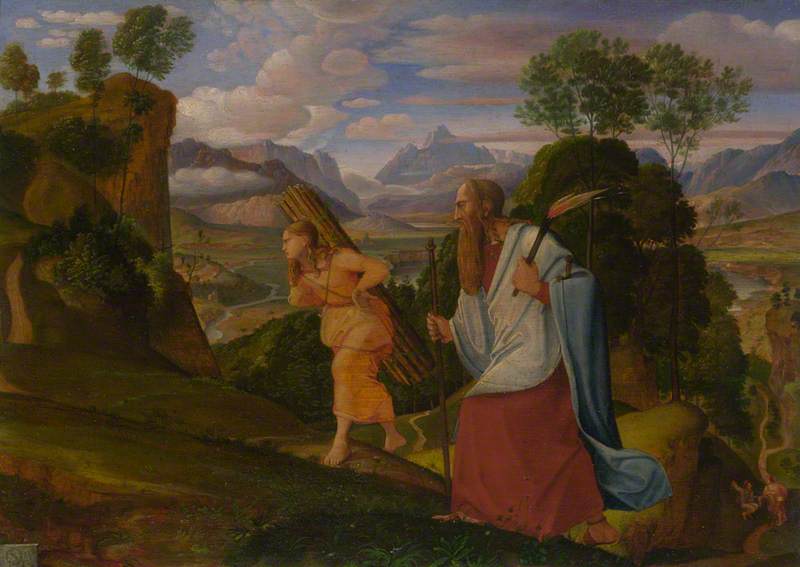
Abraham is called by God to leave the security of his family and make something of himself, and he is called to do so late in life. Though seemingly not eager to do this, Abraham listens to God and becomes a sojourner along with his wife Sarah (initially Abram and Sarai, but I am taking the names with which they died, for simplicity). Throughout their journey, Abraham perpetually doubts God’s Providence and attempts to protect himself by lying or cheating due to his attachment to worldly things (this is particularly so with his wife); this happens repeatedly throughout Abraham’s adventure as recounted in Genesis, and this theme merely comes to a head with regard to Isaac. God promises the birth of Isaac, an only child for the aged Abraham and Sarah, who is to be the progeny that will spawn a great nation from Abraham’s line. In this way, Abraham sees Isaac as everything; he is the fulfillment of all for which Abraham has risked his life and left any safety. Isaac, therefore, becomes to Abraham as the fruit in the Garden of Eden was to Adam and Eve; Isaac is a ‘something in the world’ in which Abraham believes his salvation lies, and therefore Isaac becomes a kind of idol.
I wish to pause here to suggest that this form of idolatry is nearly ubiquitous among parents. In my own case, my wife and I had our first child just a couple months ago. Due to the specifics of our circumstance, mom and baby needed to stay at the hospital for forty-eight hours as opposed to the twenty-four we were initially told. I therefore needed to run home to get more baby supplies and fresh clothes for my wife and I. During this brief errand, I was alone for the first time since our son’s birth and disposed to reflect on how much our lives had just changed, and I was struck by a rather jarring thought: I had the intimation that – not necessarily in capacity but at least in intent – I would be willing to literally burn the world down if I thought it would protect my son. I thought, ‘What a silly notion, yet I feel it so earnestly. Evidently, that would do nothing for him, but this also makes sense of how I have heard so many people speak about their affections and duty toward their children.’ I want to contend that this feeling, this intimation, is precisely what Abraham felt toward Isaac – perhaps more so, due to the promises God had made to Abraham regarding what would come about through Isaac and his subsequent generations. Abraham, like us, was willing to put his child before existence in its totality, and this is evidently irrational; nevertheless, it seems to be nearly universal among parents. There is perhaps a partial truth in this sentiment, as it allows us to have the wherewithal to endure for our children – but there must be limitations.
Let us return to the Binding of Isaac story. What God is commanding in this story, therefore, is not merely a child sacrifice. Instead, this story is about a relational and personal God trying to reveal something to His broken creature. This is not just some abstract human of whom we are speaking; this is a creature whose heart God knows perfectly, and He is therefore responding to Abraham as he is in all his fallenness. God knows that Abraham has this sinful inclination to idolize his own son, and therefore He must reform Abraham in order to overcome this warped love. It is only within this narrative flow, recognized as nearly universal among parents, that we see the relevance of this story. God tells Abraham to sacrifice his son because, even if we must love our kin, the idea that we will destroy the world for the sake of our child is simply disordered; in believing such ideas, we have put the creature before the whole of Creation and its Creator. God commands Abraham to perform the sacrifice of Isaac precisely because this is what Abraham needed to genuinely move his heart from the disordered idolatry of his son. Without the willingness to go through with the sacrifice, Abraham was likely to remain in his sinful state. Critically, it is when Abraham shows himself as willing to go through with the sacrifice that God knows the idolatrous inclination has been stamped out; He then stops Abraham and provides a ram in Isaac’s place, retaining His promise that Isaac will bear further generations. In some sense, God pushes Abraham to live in the tension of his duty both toward God Himself and his son, Isaac; God never wanted the sacrifice for its own sake but used this ritual to move His creature’s heart into a more orderly form regarding his relationship to his child.
We can therefore return to some claims that I made above. I suggested that the Bible is a book motivated by this fundamental question: What does it mean for me, a human being, to live in accordance with the will that moves existence itself? In my view, then, the Binding of Isaac is a story representing a slightly more specific variant of this question: What is the proper calibration that I am to have as a parent between my duty to my children and my relationship to the source of existence itself? The answer, Biblically derived, is that we must be willing to let go of our children, but that ultimately God does not desire this end; this is merely a state of heart we must be willing to embrace insofar as it maintains the very equilibrium of this complex cosmos in which we live. We can also recognize the power of the Bible providing this image as a narrative instead of in some kind of propositional form; the vicarious impact of the Binding of Isaac is far more salient than my rationalized account as given here, and there is – of course – the need to recognize that there are other, complementary rationalized accounts that can be just as properly derived from this story.
What I hope I have been able to do here is twofold: I hope that I have provided a more nuanced consideration for how the Bible should be read, and I pray that this reconsideration of the Binding of Isaac may have made this difficult passage more accessible to anyone who finds it arduous to interpret. The Bible is a text that was cobbled together over thousands of years and encompasses complex, varied, and contingent responses to the ultimate questions of life. The Binding of Isaac is a response to one specific instance of wrestling with our human predicament, and it may even be hard to swallow – but I believe we should take on such difficult notions not as mere antiquarian foppery but truly profound contentions with the mystery of our existence itself. Reading the Bible is not merely studying a text; it is confronting a vast conversation about what it means to become who we are.

 Hoping for Clarity