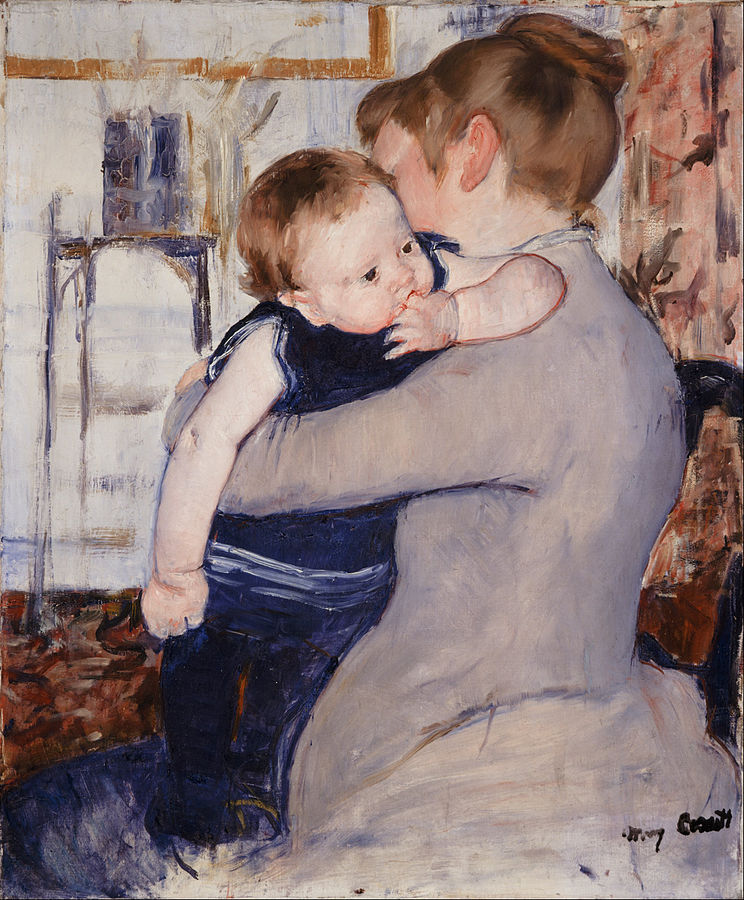
After having run a few errands, I returned home to find my wife and infant son resting on the couch after what seemed to have been quite a good feeding. Though he has not yet figured out his facial muscles and the relevant expressions that display certain emotions, I could tell given his posture and ease that he was soaking in the comfort and joy of a moment that he likely knew better only in the womb. My wife was sat quietly observing him, examining every detail of his little face while ensuring that she not disturb his repose. Despite having my hands full and needing to put various items away, I silently halted and simply stared at the two of them for a few minutes. It was a moment that did not need anything else; it was perfect in itself, and I felt that I could rest in its delight while it lasted.
Though new to breath and chill, the skin and heart
recall what once he knew as all the world;
a bond maintained, despite them now apart.
Soft skin, light grip, tiny toes slightly curled –
yes, we must think of all that could or should,
but, for now, abating thoughts of boyhood.
This little moment was an experience that I understand as being something of an intrusion of the poetical. I mean this not merely in that I felt it could be captured in a poem (for I believe that the delight of a poem is at least partially distinct from that of any experience that may inspire it), but rather that it had a character that is distinct from that of most of our experience: it invokes a sense of delight in itself and for its own sake. It is not for something else; it is not trying to explain phenomenological realities; it is not a theorizing of postulates. It is merely a moment in which one of the many goings-on of these brief lives we live seems perfect and therefore worthy to be merely stayed with; it is not used or looked beyond for to do so would be to miss the delight.
Now, for those who enjoy poetry as such or any other art form (perhaps the visual arts or musical composition), it may be possible to actively pursue and attain poetical delight by some conscious effort. Indeed, it seems to me that one critical aspect of the liberal arts is that they help us to procure this skill of inducing the poetical in one form or another; a man who is free and chooses to pursue some end for its own sake (and far beyond mere utility) must learn to do so. I would argue, however, that it is far more often that people (especially nowadays) do not have these skills. Moreover, even those who do have the capacity to induce the poetical intentionally are often at pains to do so. Especially in our overly technological age, everything is about productivity and generation; such an age does everything it can to make us overly concerned about the next decade, year, month, day, or even hour. What is never considered is that we only ever have the present as such; the future is merely an imagined moment that we never contact, for our arrival transforms it into the present from which we are still distracted by that ever fleeting future.
Fortunately, the world is not so monotonous and utilitarian as our civilization has tried to convince us; despite the ever-felt need to gain more income, to pursue another project, or make another plan, there are times when we recognize that living outside the present is simply self-defeating. I think this is most commonly found in friendship, for to desire anything but a friend in himself is to simply lose him. There are, however, many times in which I believe the poetical ‘breaks in’ to our goal-striving and deadline meeting. This may be that a man, while on his lunch break, is struck by the sight of a breeze flowing through the tree that lives in the rooftop garden of the skyscraper in which he spends ten hours a day; a first-grade boy, while learning arithmetic, might note the funny way in which his class goldfish likes to blow bubbles in a syncopated pattern; a wife might delight in the funny way her husband unthinkingly wiggles his hips back and forth while sweeping up the floors. In each case, these instances simply happen to observer. The sole obligation of each agent in their respective instances is to not pull themselves from the delight of the moment – to not be distracted by thoughts of what is to be done or how things could be rethought.
To recognize this is not to suggest that all activities that are done for the sake of something else are not worthwhile or somehow illegitimate. No one should be scorned for working an honest wage in a job he may not love in order to provide for his family; a child need not delight in every minute of learning to trace out the letters of whatever alphabet his mother tongue uses; a husband should not be expected to enjoy taking out the trash in itself. In each of these cases, the activity executed is done for the sake of the ‘end’ as opposed to the ‘means,’ and we can acknowledge that these objectives are very well desirable even if they entail a process that we do not love for its own sake. Critical here is the perception that there must be some point at which he returns to the present. The father working a wage must ultimately rest in the company of his family; the child must eventually learn to appreciate his capacity to read and write in itself; and the husband knows that the proper execution of his chores makes for a cleaner and happier home.

The poetical is thus a form of experience that reminds us of this need to come back to the present for it is the only time in which we truly experience joy. The contemplation of possible pleasures in the future pales in comparison to the actuality of even a lesser delight in the present; the poetical as such is incapable of existing in the future – it can only be had in the immediacy of one’s experience, and thus it calls us back from perpetually delaying the love of the present. This should not, however, lead us to some form of imprudent presentism. In all we have said here, we must recognize that the future will in fact come; the present is always transforming, and a foppish clutching of any given moment can quickly turn us into irrational lovers of the past. This can cause as much pain and alienation as trying to live in the future. In my view, this is why we often see the same sorts of discontent in both antiquarians and futurists; they may have different conceptions of how they wish for the world to not be what it is now, but they commonly hold that the present is unworthy.
We thus seem to be at something of an impasse. We try to live for the present, to enjoy what is right before us, and yet that moment is ever slipping from our grip. We ought not foolishly try to more firmly grasp the ‘now,’ yet we simultaneously cannot simply let go to reach out to some far off hope of what may be. Despite my initial note about the poetical and letting it break in, have we not arrived at the conclusion that the temporal reality of human life is simply a tragedy for which there is no cure? Unsurprisingly, I am not so pessimistic. In fact, I believe that a proper disposition towards the poetical provides us with an intimation of how our lives in their entirety can be shot through with the joy that only comes from learning to live in and love the present. What is this lesson that can be learned from allowing the poetical to take hold for the brief moments that it does?
When confronted with the perfection of any given moment – be that a sweet sight of your wife and child, a tree dancing in the wind, a fish playing with bubbles, or a spouse unknowingly dancing – we begin to recognize that the joy found in them is not something earned or won. Such delights are much better thought of as given or, better, gifted. Even in those cases wherein we have learned some particular art in which we find this sense of poetical delight, we realize that the beauty and contentment provided is not so much something we have learned to create but something to which we have learned to be attentive. The delight of a poem, even when I am its author, is not so much in that I created it and can glee in that achievement; rather, it is found in the wonder that I can participate in the construction of words and phrases – none of which I am the originator – in such a manner that they can instill a love of the present. Perhaps this was why many of the ancients spoke of the Muses – those peoples of old recognized that their artistry was never precisely their own.
If, therefore, the poetical helps us to see the giftedness of experience, we can compare it with receiving a particular gift in some ways. More specifically, I like to compare it to hearing affirmative words of affection from someone who loves you. As he or she speaks, you can simply exist in the joy of reflecting on each word and what it means for the delight known through your relationship to one another; moreover, if your lover’s words were to continue forever, they would simply become meaningless, and they may in fact be all the sweeter due to their brevity and scarcity. We also know that much of the content that would be expressed in such a moment likely also came with much hardship. Lastly, their words would seem tainted or skewed if you were not both prepared to continue on with the relationship and all the good and bad that it may entail. The receptivity of the poetical allows for us to learn to appreciate the givenness of the present, and this gift is made delightful by its very ephemerality; to know this, then, is to not be hostile to the future but live in the hope that another gift, another delightful present, may come.
Looking at the love exuding from my wife and son, I try to keep hold of it for just a long as is acceptable, but I know that there are groceries to be put away and other remedial tasks to which I must attend. Nevertheless, looking upon the juvenile peace of my son, I am flooded with a love precisely because I know that this time will come to close; if I do not live in this love now, I might miss the details of what is right in front of me. The poetical calls us to maintain a proper orientation to our brief time given in this life, even when joy and delight are not at the forefront of each moment; allowing ourselves to be open to its call is a reminder that we only ever have the present and we must not lose sight of the fact that, often because of our own vain ruminations, it is irretrievably slipping away.
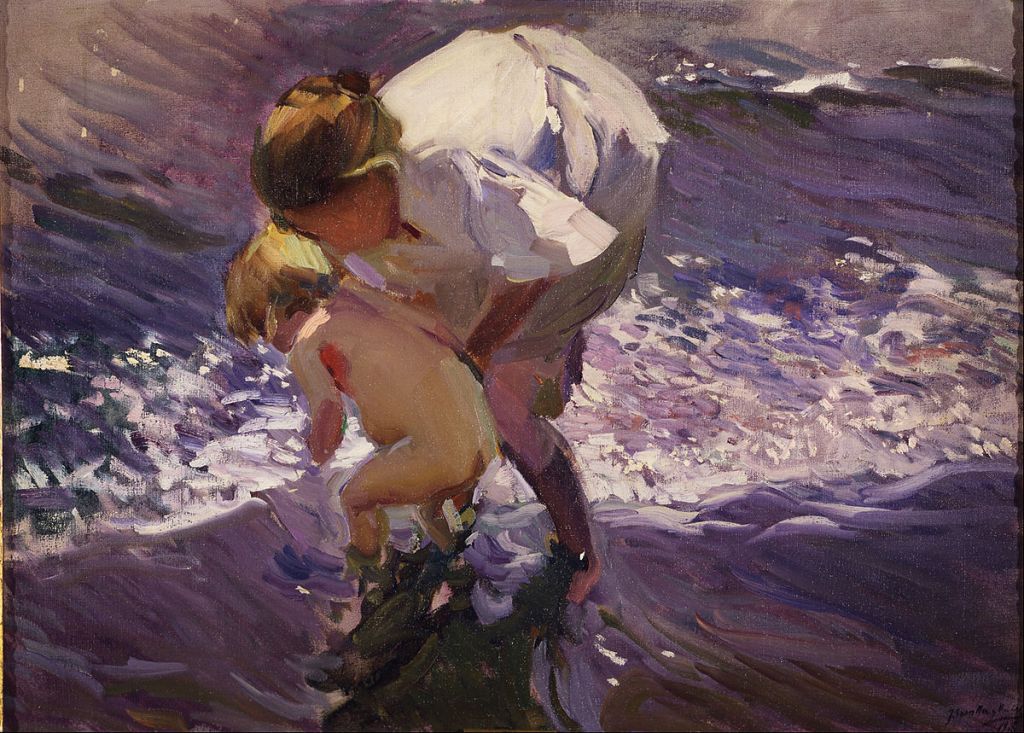
This were to be new-made when thou art old,
And see thy blood warm when thou feel’st it cold.
-Shakespeare, Sonnet II
 Hoping for Clarity
This piece, while philosophical, truly has the quality of devotional writing: it clarifies the meaning of wonder, while also inducing it…. You communicate through your writing that very giftedness of experience which has itself impelled you to take up your pen: gratias tibi ago!
LikeLiked by 1 person
Brilliantly put!
LikeLiked by 1 person
Reading this, I received much. Thank you for sharing your gifted expression.
LikeLiked by 1 person