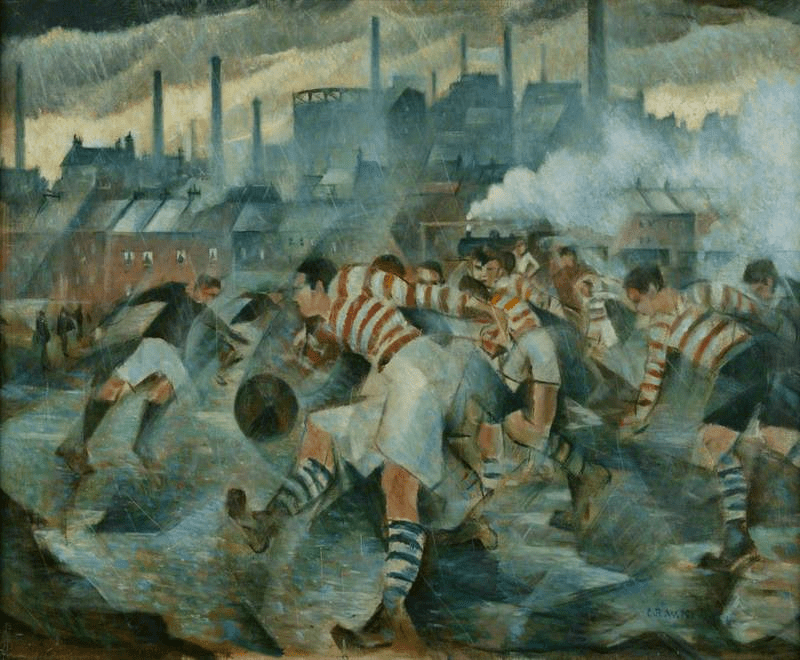
I came across a clip from a philosophy-focused Youtuber who was discussing the odd nature of what it means to support a sports team. He ventures through a number of logical dilemmas with his guest that are all quite preposterous; they tend to rely on rather bizarre circumstances that, as far as I know, have never been practically realized and are therefore without real stakes. Nevertheless, it gave me some pause to think about why we continue to do the things that we do – a task quite different from doing the things that we do.
Despite the amusing ramblings about sports and their odd cultures, there is a peculiar phrase about why sports teams matter that is used by the guest on the program which jarred me when I first heard it: “There is some sort of truth to it, that we assign to it, and – thereby identifying with it – we can stabilize aspects of ourselves” (7:52-8:02). This is a rather odd phrase if one stays with it for a moment. In this statement, there is an insinuation that there is something about truth that we ‘assign’ – yet this generates a number of problems. Now, before continuing, it is not my desire to beat up on this chap for an offhand comment made in some off-the-cuff conversation – this would be unfair, and I intend no scorn. Rather, in his quoted phrase, I think we have something of a real problem that afflicts us and our thinking today. We tend toward the relativistic, toward the idea that choices are merely capricious and have no solid meaning (and therefore cannot be evaluated by another); I think this is a bit facile, and I would like to offer one soft challenge to this view.
Does the bloke who goes to the local football match (or whatever other sporting event) merely assign value to the engagement and then consequently enjoy his experience? Quite obviously, I think the answer must be no. If this were the case, we would have to suggest that he could have assigned it to anything he pleases. If such value is merely assigned, I might suggest that he assign value to visiting a local farmers’ market or attending a fashion show. Evidently, this is silly. One cannot simply posit such value and suddenly find the relevant event interesting – there must be some other factor that grounds him beyond his own will.
I think, however, that there is something of an answer provided in that same phrase. I believe we can, in fact, commend the guest interlocutor for including an interesting clause in the above-quoted phrase: “We can stabilize aspects of ourselves.” In this particular instance, this fellow is suggesting that team sports can give us some kind of identity that we inhabit and participate in that provides some sense of purpose. Someone might have grown up supporting Chelsea FC because of his father’s love for the club which was followed by years of playfully rivalry with his friends who supported Arsenal and Manchester City; he remembers the time when his club won the Premier League and he cheered like never before, and he remembers another time when his mate graciously bought him a beer when his own club trounced upon Chelsea in a great upset.
In short, our lives, in their all complexity, wrap themselves around such seemingly trivial events – but, due to this integration, to call them trivial is perhaps not fair. Moreover, I believe we will begin to see that such playful moments are wrapped up in the many aspects of life that are far from chosen. One does not choose which club his father supports – but to not follow one’s father in such things as a little boy seems odd, for you follow him in so many other instances. (I remember, when I was eleven years old, my grandparents bought me a New York Giants (American) football jersey; I have little interest in the NFL, and yet – if I find myself at a bar or at a friend’s watching a game – I have this soft pull to root for them. I do not believe it was because I cared at all for the team; I think it was because I did and do love my Grammie & Poppy.) Thus, our identities are utterly wrapped up in these decisions. There is an entire ‘practice,’ a way of doing, that surrounds the enterprise that is integrated with many other aspects of our lives that can help to fill in the gaps beyond it being something I assign. It is, in my view, something better thought of as recognized and then adopted.
This is but a brief note on the subject, and I must admit that I have not fully addressed the claim with which I began. Do we merely assign meaning to things, or do things beyond ourselves inherently have meaning? I have herein suggested that we should lean toward the latter. This does not mean that human creativity and artifice have no play or affect in such affairs, but I think it is foolish – and perhaps even dangerous – to posit that meaning is something we capriciously designate without reason, and it seems antithetical to reason to say that it is merely ‘mine.’ Moreover, there is a deeper conversation to be had about the complex nexus that is ourselves which integrates the many things in which we find value. (This is why the blabbering on about a recent match result is more concerning in a man who is going through a divorce and being estranged from his children than such idle talk would be in a man who has his house in order.) But such deeper concerns will have to be mine on another day.
 Hoping for Clarity
Brilliant, Quinton: astute insights into what makes us tick!
LikeLiked by 1 person