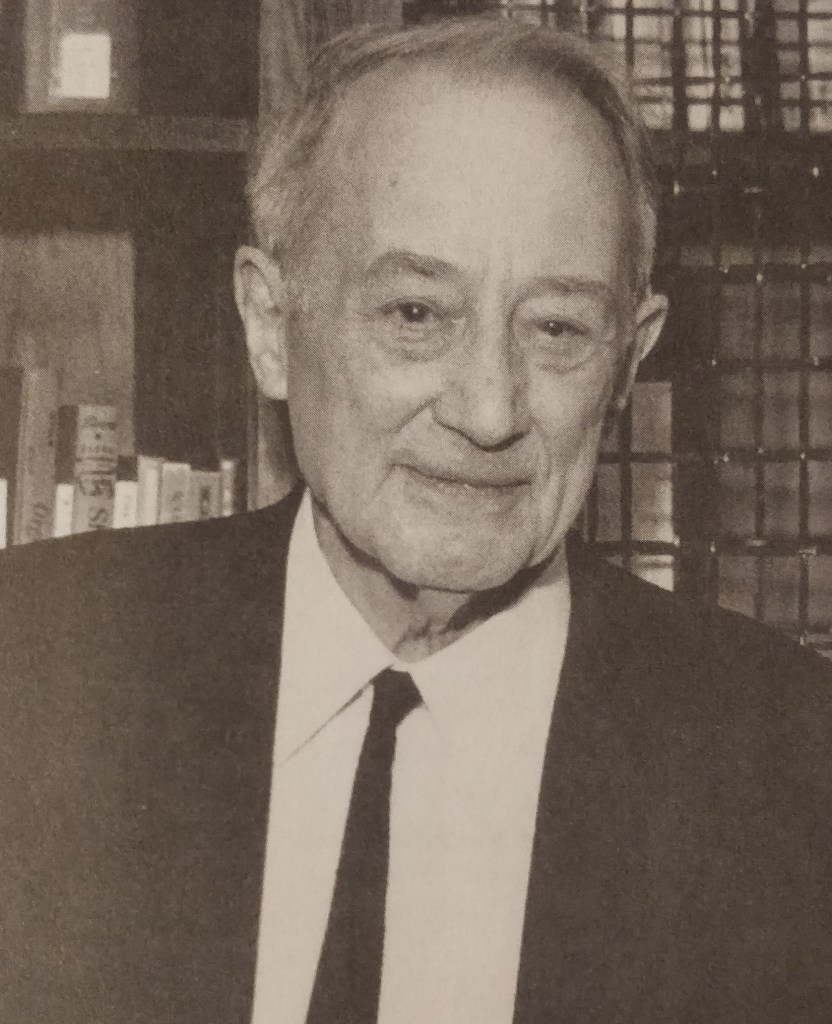
As is no surprise to anyone who knows me well or has taken a look around my blogsite and the posts I have released so far, my own thought is deeply indebted to the work of the twentieth century philosopher, Michael Oakeshott. Despite that he is often viewed as a predominantly political thinker, focusing largely in conservatism, I have been much more influenced by his philosophic thought (which has had, I must concede, something of an effect on my political thought as well). Oakeshott has a rather peculiar view of philosophy, seeing it as a sort of arbiter among the many voices present within human experience.
There is virtually no limit to the voices present within human conduct; we could understand this in the sense that every unique individual is a voice, however, Oakeshott typically understands them as different idioms which are present in human experience such as the voices of science, history, politics, economics, practice, etc. These various voices are modes of expression, often having different underlying assumptions, different emphases of what is important, and all aim toward different ends. Philosophy, however, is not like the other voices in that its sole purpose is to ensure that no one voice becomes dominant; philosophy has none of its own assumptions and must be entirely open, meaning that it will frequently act as a critic of the other voices to ensure we do not believe that only science or history or practice can explain the full scope of our experience.
As you have likely deduced from the title of this post and my summarizing of Oakeshott’s view of human activity as a collection of voices, this develops into a metaphor of human experience as a conversation, which is most clearly elucidated by Oakeshott in his essay, “The voice of poetry in the conversation of mankind.”[i] It must be highlighted that “conversation is not an enterprise designed to yield extrinsic profit, a contest where a winner gets a prize, nor is it an activity of exegesis; it is an unrehearsed intellectual adventure.” The purpose of conversation is not an end destination but the actual act of having contributed to it; to cease participating in the conversation is not to be feared, for our contribution can only set in and make a difference in the conversation once our own voice ceases so as to allow the other voices to contribute once more.
Why, now, am I going over this concept that Oakeshott outlines?
Something I believe, which could be contested, is that our age is one in which it is exceedingly difficult to find a stable sense of meaning for oneself. This could, of course, simply be the mark of every era, and I am erroneously believing that we have been the first people to experience something of this nature; perhaps I could also be projecting upon the world what I have felt at some significant moments of my own life. Despite these possibilities, I do think that this is something that mars the life of a great many people. I also am surely not the first to think that such is the case, as a great part of the conversation for intellectuals in twentieth century Europe was about this exact issue.
To take one example, I will go to one of the great inspirations for much of the discussion around such a “crisis of meaning” in the modern era: Max Weber. Weber was a German sociologist, but his knowledge and expertise was certainly not reduceable to the field of sociology which he, himself, aided in concretizing as a distinct discipline. Weber was a man who had a great deal of knowledge about religion, philosophy, language, and history, in addition to the sciences to which he was a more significant contributor. Weber, in my view, can be considered one of the most prolific links between the realms of the humanities and the sciences, though it is debatable how well he held these two worlds in tension.
In his lecture ‘Wissenschaft als Beruf’[ii] (Science as a Vocation), Weber argues that a great plight of the modern era is that any meaning to be found in death has eroded. With the improvement of the Sciences, among many other fields such as history or linguistics, there has been a movement toward understanding improvement as progress. This is not something which is uncommon to our present way of speaking; politics is often discussed in the context of progress, great civil rights movements or human rights declarations are seen as progress against the old ways of an outmoded tradition. At first, we may be encouraged to cheer on as such things continually happen; of course we want more liberties, of course we want more rights, of course we want to improve upon our past—what could possibly be the issue?
Weber, in echo of the great Russian novelist Leo Tolstoy, argues that this notion of progress has robbed humanity of its capacity to live in the present. To what end does the Scientist, the Historian, or the Politician work? If we understand all things which are good as being progress, then we know that everything we have lived for now will quickly be outmoded and irrelevant. All we have lived for will have been not for our lives but for someone else’s. Worse yet, this problem will recur in every generation as each lives for the next. This phenomenon will have two effects: the first is that death will rob from every person the capacity to see the much awaited ‘better’ future they have been building; and the second will be that if the good is always something situated in the future, we will quickly begin to lose sight of what is truly good because it will never be present for us.
In my view, these two aspects of conflating our concepts of goodness and progress have already occurred in our society and the damaging effects are setting in. The first aspect can be seen in movements such as transhumanism that are attempting to use technology to escape the reality of death, or from the ways that people during this COVID-19 pandemic have shown their willingness to have everyone maintain an indefinite isolation (and perhaps even enforced indefinite isolation), foregoing the possibility of much needed human interaction and contact, only to preserve one’s capacity to merely keep breathing. The second aspect can be seen, ultimately, in the severe clashing of ideals and desirable ways of life in political, social, and economic discourse. We appear, to my eye, to be living in a culture where everyone is living for some future time to come, without ever considering when precisely they will be happy with their present conditions. In the wise words of Simone Weil:
“When we are disappointed by a pleasure which we have been expecting and which comes, the disappointment is because we were expecting the future, and as soon as it is there it is present. We want the future to be there without ceasing to be future.”[iii]
We need therefore, in my view, a reorientation of how we understand the purpose of us being here. This is not to say that this will provide any of us with a concrete plan for how to live their lives from this point forward, but rather to put our actions within a more holistic vision that provides a reason to enjoy life for its own sake as it presents itself to us. And I believe that this reorientation has been provided for us in the view that Oakeshott has of understanding our fleeting time in the cosmos as conversational in nature.
In a way much akin to the view expounded by Weber, Oakeshott fears that the voice of science has become dominant in the conversation of mankind. Science is, more often than not, more concerned with being argumentative than discursive, looking to establish hard “facts” and determinate answers to certain questions. Oakeshott does not intend to diminish the contributions to be found by a scientific voice, for “of course there is argument and inquiry of information, but wherever these are profitable they are to be recognized as passages in this conversation, and perhaps they are not the most captivating of passages.” There is no ‘final answer’ or ‘final solution’ (God forbid our race ever use such a term again) to the fullness of life; rather, the purpose is to be as open as can be to the possibilities of experience, never closing oneself off from any one aspect of the conversation. If we simply experience all of life in a scientific manner, there is far more to be lost than gained, and we must seek something more.
This is why Oakeshott develops a notion of a ‘poetic’ or ‘aesthetic’ voice that is a distinct and deliberate idiom of activity, but one which is seldom present and more often misunderstood. It will suffice, for now (I intend, at some point, to reflect more deeply upon the poetic voice in its own right), to say that this lesser known idiom is the counteracting force to the eristic monopoly occasionally sought by the voice of science. Poetic activity is concerned with the expression and collection of images as seems fitting for a subject without consideration for the mediation of others or a method such as that of the sciences; poetic activity is “like a girl bunching flowers, considering only how they will appear together,” never focusing for too long so as to stumble into the muddied water of ‘facticity’ or ‘truth.’ Poetic activity is simply the delightful contemplation of an aspect of experience in the present, something to enjoy for its own sake for a fleeting but lovely moment.
Oakeshott has thus provided us with an understanding of what may be considered historical or scientific ‘progress’ which is within a framework that is far more sustainable and has other modes of experience that are equally worth considering and taking part in. For every moment that we desire to progress into the future of scientific inquiry, we have one in which we may merely delight in the warmth of the Sun’s rays or the joy of a puppy met in the street, an experience that can be found nowhere but in the present. Progress is no longer the defining feature of what we consider to be ‘good,’ and it may only, occasionally, contribute toward our conception of the good life.
I would press on with Oakeshott’s metaphor yet one step further. If we consider our experience as being a mere exploration, with no final end goal or destination, we begin to realise that we are not meant to simply achieve some end out in the world such as a scientific discovery or a new epoch of history generated. Rather, the purpose of our lives becomes merely the engagement with all that is revealed to us in experience. To contribute to the conversation—to love, to play, to compete, to encourage, to give, to receive, and to appreciate—is the end, and it is not something which can be taken from anyone who understands the world in this way.
“As I understand it, the excellence of this conversation springs from a tension between seriousness and playfulness. Each voice represents a serious engagement (though it is serious not merely in respect of its being pursued for the conclusion it promises); and without this seriousness the conversation would lack impetus. But in its participation in the conversation each voice learns to be playful, learn to understand itself conversationally and to recognize itself as a voice among voices. As with children, who are great conversationists, the playfulness is always serious and the seriousness in the end is only play.”
[i] Oakeshott, Michael. “The voice of poetry in the conversation of mankind.” In Rationalism in politics and other essays. Indianapolis, IN: Liberty Fund, 1991.
[ii] Weber, Max. “Science as a Vocation.” In The Vocation Lectures. Translated by David Owen and Tracy B. Strong. Indianapolis, 1-31. IN: Hackett Publishing Company, 2004.
[iii] Weil, Simone. Gravity and Grace. Translated by Arthur Willis. Lincoln, NE: Bison Books of The University of Nebraska Press, 1997.
 Hoping for Clarity