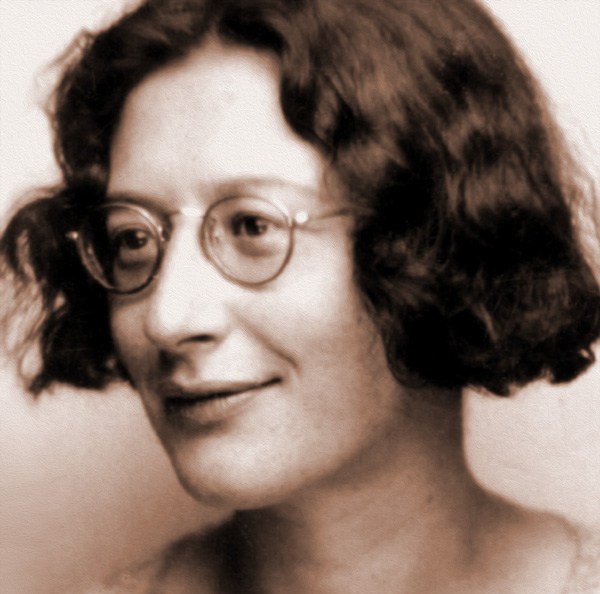
One unexpected gem that I stumbled upon in the first semester of my Masters degree is the French mystical thinker, Simone Weil. To say that she is a writer who is difficult to define is a significant understatement; her influences have a dynamic and seemingly contradictory range, with three crucial ones being Plato, Karl Marx, and Jesus Christ. Unfortunately, despite all the insight that her brilliance may have offered us, we may be at some loss since Weil died at the young age of thirty-four in 1943. Her exact cause of death is unknown, though it likely was due to some combination of being malnourished and the illnesses that ensued due to her body’s feeble state. This unhealthy circumstance was brought about by her own choices: she decided that she would live like the soldiers serving on the battlefront against the Nazis in the Second World War, meaning that she rationed her own food and water, slept little, and partook in nearly no pleasures to ease her pain. She wanted to be among those suffering, but could not serve; thus, she chose to participate as well as she could, and it cost her life. In the hopes that her conviction was not held in vain and that her brilliance be not swept away into the abyss of forgotten history , I wish to echo one of her thoughts here, as it is an idea that I have not stopped considering since I first came across it some months ago.
In what is considered her main mystical and (arguably) theological text, Weil discusses two concepts in relation to one another: imagination and attention. How exactly these are related may seem obscure to us. These two human faculties tend to be used in rather disconnected ways—the former being a detachment from the world which allows for an escape into one’s own mind, while the latter is a strict negation of theorizing about anything and simply trying to perceive something. Weil, however, believes that these two things are connected, at least in one way, by that which they respond to: the Unknown or the Void.
To say that the Unknown or the Void is a ‘nothingness’ is utterly inadequate; rather than some benign lack of anything which ‘nothingness’ entails, the Void lacks even the determinacy of nothingness. With nothingness, you can at least know that it is indeed nothing—with the Void, it has the potential to be nothing, everything, or anything in between. It is the confrontation with what is not understood in the ultimate sense, for even the beginning of understanding and conceiving of the object is unclear. This is the point at which Weil believes that we have a choice: we can either react to this Void with Imagination or with Attention.
Weil says that this confrontation with the Void is more commonly met with Imagination. Imagination has the tendency to try and fill the Void; she who is confronted with the Void uses up her present knowledge to imagine what the Void may be and thus fills the “unknowness” of what she is confronting. Weil sees a great danger in this, as “the imagination, filler of the void, is essentially a liar,” because what the Void truly is will be obscured by whatever the imagination guesses that the Void is—thus, the use of imagination when confronted with the Void is to bring oneself into a state of ‘unreality,’ for the Void will be known as we imagine it to be, not as it truly is.
This is the virtue of Attention for Weil: as opposed to the Imagination, Attention simply negates thought in whoever is confronting the Void and allows for the reality of the Unknown to impose itself upon the observer. Weil goes so far to say that this form of confronting the Void eliminates thought even of oneself; she believes that to truly understanding something, an “attention which is so full that the “I” disappears, is required of me.” There is no guess work, no possibilities, no confusion—there is merely the thing which presents itself to the observer as it emerges from the Void.
Now, one may object and say, ‘This all sounds well and good, but how can one ever completely negate their thoughts and just “pay attention”? I doubt that such is even possible.’ My short answer to such an objection would be: ‘That’s probably right,’ but the devil always rests in the details. I would be inclined to agree that attention described in Weil’s idealistic sense seems implausible. Now, I personally would not dismiss the idea that it could be achieved if practiced deeply—perhaps such a level of attention is possible to a select few with extraordinary gifts. I would also caution those who believe that even a select few could never achieve such a state to not reject Weil’s notion of Attention out of hand; there may still be something for us to glean from this dichotomy between Imagination and Attention even if pure Attention is seemingly improbable.
For myself, the question that has emerged is: “What do I truly know?” When I think and act in the world, what do I do that is predicated on how I imagine the world and what is predicated on me paying attention to the world to understand the world as it truly is? What if everything which I think I know was truly the Void, and I have merely filled it with what I imagined it to be and not understood it as it truly is? This should be a challenge to any of us, and something which we can perhaps focus on in these peculiar times when we are less busy, less preoccupied, and have some more time for reflection. As a first exercise, we can try simply to look to someone that we love: what do we truly know about him? Do we understand him as he truly is (by paying attention to him), or do we merely think about him as we imagine him to be?
Perhaps our imaginations are not so wrong. We likely live in a state that rests somewhere between a mode of imagination and a mode of attention. There may even be things which our imaginations are able to accurately predict. The imagination is not, however, likely to collect the full detail of the object we are pursuing, which is essential to fully loving all of something and requires us to be wholly open to that thing. No preconceived notions. No assumptions. No theories. Just attention. It is in these moments that someone may disclose something to you that you never could have imagined about him—something which deepens the connection that you both have and could only have come about through confronting him as he truly is. This is the key to Attention’s power over Imagination: attention may reveal that which the imagination never could have reasoned.
“To accept the fact that they are other than the creatures of our imagination is to imitate the renunciation of God. I also am other than what I imagine myself to be. To know this is forgiveness.”
-Simone Weil, Gravity & Grace
Ό Θεός αγαπά τόν κόσμος.
 Hoping for Clarity