As has been the case for many of us over the last little while, I have been nearly confined to my little apartment with my roommate. This has meant that we have likely had more interaction and conversation over the last week than we have during the past six months. Despite that we get along very well, there are times when we of course get on each other’s nerves. I think he has now had to look at me and ask, “Are you honestly still talking?” about four or five times now (which was not rude—his pointed question was unfortunately reasonable). Thus, doing what I do, instead of talking I thought I would sit down for a moment and write about conversation and how important it is to protect it.
The last essay that I wrote during my undergraduate degree was a textual exegesis on one of Plato’s dialogues, the ‘Phaedo.’ Basically, that just means I had to dumb down some complex philosophy and explain what I believed the message of the text was without any external sources. The point of exegesis is that it is just you, a book, and questions. What is the argument here? What should we learn from reading this? If someone needed to know the core of this text in thirty seconds, what would you tell them? Is this still relevant today? (This last question, despite that Plato was writing in Athens 2500 years ago is obviously an emphatic YES.)
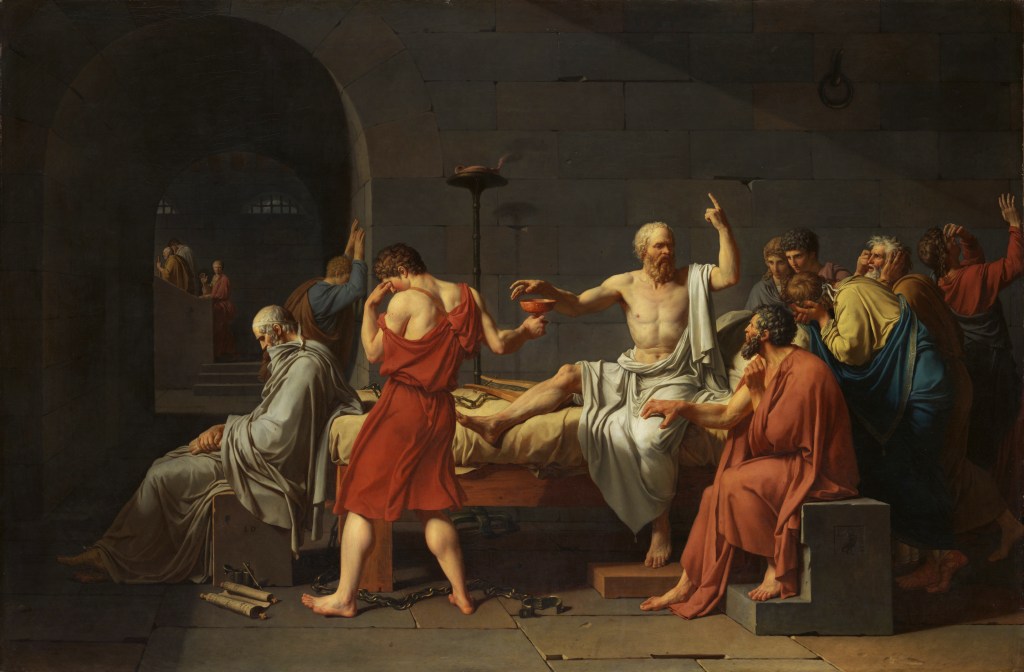
Now, without going into all the details of the dialogue, as it is rather obscure, I do want to focus on the setting in which Plato’s text takes place and one of the main things that is spoken of by the main character of the text, Socrates. Plato writes in a dialogue format, which reads, in a way, like a play. All that Plato provides for his reader is a conversation, one in which you are told who is speaking and who they are addressing. You are thus left with a series of combating ideas, as various characters provide their points of view and are then left to debate the finer details and contradictions (with Socrates almost always being Plato’s character who leads the way through these intellectual journeys). This Socrates, however, was also a real man. He was a teacher of Plato himself, though he either had no writings of his own or we have none of them now. Socrates was a bit of a pest in Ancient Athens, as his way of being a philosopher was to just walk around asking people why they think things and why they act in certain ways (which is clearly annoying, but perhaps something we could use a bit more of every now and then). This pestering, however, caused Socrates to run into conflict with several powerful Athenians who had him charged with blasphemy and abuse of children for his actions. Socrates was ultimately condemned to death; his execution to be by drinking hemlock, a kind of poison.
The ‘Phaedo’ takes place on the day of Socrates’s execution. Several of his friends go to visit him to say goodbye one final time. Instead of complaining of his circumstance and lamenting, however, Socrates prompts his friends to become his interlocutors once more—to have one final philosophic discussion. Along with two of his friends, Cebes and Simmias, Socrates discusses what the purpose of philosophy is, how this relates to death, and how they can use myth to understand such difficult topics. Socrates is clearly the most skilled of the three debaters; he essentially places both Cebes and Simmias on his back for much of the conversation and moves them to understand everything they are discussing more critically and thoroughly (perhaps being critical and thorough are not so different).
As much as I love the whole of this dialogue, there is one part in particular that stands out to me and is of such relevance for my thoughts today. A little more than halfway through their conversation, Cebes and Simmias start to become somewhat sluggish and cease to ask Socrates any substantive questions. In this moment, Socrates has a brief interlude to dispense some practical wisdom that I think we could all use, whether we are on death row in the Ancient Athenian Polis or sitting with the same few people for weeks on end during a period of self-isolation.
Socrates warns his friends that there is one thing that we should be wary of, which is “that we should not become misologues, as people become misanthropes. There is no greater evil one can suffer than to hate reasonable discourse.” Playing off this latter term, ‘misanthrope,’ Socrates jokingly puts forth a new sort of man: a ‘misologue.’ He is the one who ceases to delight in conversation itself, but rather forever uses it as a tool, thinking that conversation in and of itself is meaningless. Socrates explains how “misology and misanthropy arise in the same way. Misanthropy comes when a man without knowledge or skill has placed great trust in someone and believes him to be altogether truthful, sound and trustworthy; then, a short time afterwards he finds him to be wicked and unreliable, and then this happens in another case; when one has frequently had that experience, especially with those whom one believed to be one’s closest friends, then, in the end, after many such blows, one comes to hate all men and to believe that no one is sound in any way at all.”
I do not think I know anyone who cannot, to some degree, relate to what Socrates has said here. Aside from a very lucky few among us, I would gather that most of us have had someone hurt us in some way or another, whether that be a wound large or small. Perhaps someone ridiculed you for something you were already ashamed of in yourself; perhaps someone promised you something but never followed through; perhaps you were told you were loved, but you’ve been led to question whether you were ever cared for at all. Such moments are some of the most difficult into which us human beings will ever stumble. Despite this, however, we may have cause for hope.
The first thing I believe that we can discern from Socrates’s wisdom is that we can recognize that we too have the power to inflict such pain. How often do we consider such realities of our acts and speech? What would happen if, before ever saying anything, each of us asked: “What will it mean to this person if I do or do not remain true to my word?” Second, notice that Socrates says that such problems may arise when one is either wicked or unreliable. Those are very different reasons by which one can be hurt. To be wicked is one thing, though to be unreliable is hardly uncommon for us as human beings. We are thus confronted with two aspirations for making the future better: one, focus on holding true to what you have said you will do and ensuring that you mean what you say, so that another need not feel the damage of you being unreliable; second, allow yourself to forgive others when they may hurt you, for they may not act out of malice or spite but rather just their own ignorance and impotence that is part of their human nature. Lastly, Socrates is telling us that the only way to avoid both ‘misology’ and ‘misanthropy’ is to simply say no to them. Despite every pain, every ache, every wound that is inflicted upon you by the speech or action of another, the answer is not to reject the whole enterprise of speaking and acting in the world. The only way forward is to embrace the trials and tribulations, to push on toward what is Good, and hope that your weak nature can withstand the force of this difficult life.
For myself, this message has been continuously running through my mind during these bizarre times. Each time I have the ability to speak to someone on the phone or send a text, I think of what I am saying with great care because I do not know how long it will be until I can speak to that person again. As for my roommate, I always speak so as to encourage the conversation to stay strong and flow, hoping that it is never something that we feel we should turn away from. Is my word on this final? Of course not. Perhaps I am a charlatan, or a sophist, or a con, but the only way that we’ll be able to know is if you join in to continue the conversation.
“But in its participation in the conversation each voice learns to be playful, learns to understand itself conversationally and to recognize itself as a voice among voices. As with children, who are great conversationists, the playfulness is serious and the seriousness in the end is only play.”
-Michael Oakeshott
 Hoping for Clarity